ここから本文です
TWO:CHAPTER XXI. REIGN OF VICTORIA (continued).

Hydrocyclone (liquid cyclone)01

Hydrocyclone (liquid cyclone)02

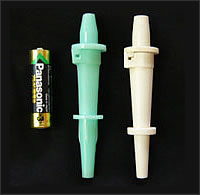
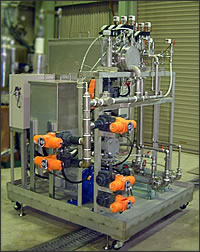
A hydrocyclone (liquid cyclone) injects treatment solution into stationary equipment to perform separation, classification, and concentration, and is an innovative separator with a very simple structure and no drive unit.

Structure of a hydrocyclone (liquid cyclone)

A suspension containing fine particles of several micrometers or more is supplied to a cylindrical container circumferentially at high speed. And as a result it starts to rotate and a centrifugal force is generated. At this time a gravitational acceleration of several tens of thousands of G is generated in the circumferential direction, and thus leading to fast sedimentation and concentration of the fine particles. The separated concentration can be freely selected by changing the supply rate (supply pressure and flow rate) and the flow ratio of the outlet. Our hydrocyclone (liquid cyclone) was designed and manufactured to classify and concentrate fine particles, and so has a small element.

THREE:When Buonaparte, early in the morning of the 18th, mounted his horse to reconnoitre Wellington's position, he was rejoiced to observe so few troops; for many were hidden behind the height on which Wellington took his stand. One of his staff suggested that Wellington would be joined by Blucher; but so wholly ignorant was Napoleon of the settled plan of the two generals that he scouted the idea. "Blucher," he said, "is defeated. He cannot rally for three days. I have seventy-five thousand men: the English only fifty thousand. The town of Brussels awaits me with open arms. The English opposition waits but for my success to raise their heads. Then adieu subsidies and farewell coalition!" And, looking again at the small body of troops visible, he exclaimed, in exultation, "I have them there at last, these English!" General Foy, who had had ample experience of "these English" in Spain, said, "Wellington never shows his troops; but, if he be yonder, I must warn your majesty that the English infantry, in close fighting, is the very devil!" And Soult, who had felt the strength of that infantry too often, confirmed Foy's assertion.The slowness with which the Government became aware of these proceedings is something astonishing in these days of telegraphs and railroads. Though Charles sailed on the 2nd of July, it was not till the 30th of the same month that Lord Tweeddale, the Scottish Secretary of State in London, was informed even that he had left Nantes. Sir John Cope was the commander of the forces in Scotland, and he immediately gave orders for drawing[94] together such troops as he had to Stirling. These were extraordinarily few. There were two regiments of dragoons, Gardiner's and Hamilton's, but both recent in the service; and the whole force at his disposal, exclusive of garrisons, did not amount to three thousand men. Cope was eager enough to march into the Highlands, even with such forces as he had, and crush the insurrection at once. He proposed this apparently active and judicious scheme to the Lords Justices in England, George II. himself being at Hanover, and they warmly approved of it, and issued their positive orders for its execution. It was, in truth, however, the most fatal scheme which could be conceived. The spirit of rebellion was fermenting in every glen and on every hill, and to march regular troops into these rugged fastnesses was only to have them shot down by invisible marksmen on all hands, and reduced to the extremity of the two companies already captured. The plan was to have secured all the passes into the Lowlands, to have drawn his forces to the foot of the mountains wherever a descent could be made, and blockade the rebels in their own hills till they should be reduced by gradual approaches and overwhelming numbers. Famine, indeed, would soon have tamed any large body of men in those sterile regions.
  • Equipment costs can be reduced.
  • Operating costs can be reduced.
  • Maintenance costs can be reduced.
  • Any change in raw material and product can be easily addressed.
  • Large amounts can be treated in a small area.
  • Separation and cleaning are easy because of the simple structure.
  • Simplified control
  • This equipment can be operated in synchronization with external devices.
  • Alarm and interlock mechanism.
THREE:As a rumour of the approaching visit of Lord Howe had reached the Spanish camp, all was in haste to anticipate his arrival, and take the huge fortress before he could succour it. Accordingly the great united fleet of Spain and France, which so lately had paraded in the English Channel, sailed into Algeciras Bay, and on the 13th of September the floating batteries were hauled out by a number of the ships, and anchored at regular distances, within six hundred yards of the English works. Whilst this extraordinary armada was approaching and disposing itself, tremendous fire was kept up from the land, with three hundred long guns and mortars, to divert the attention of the garrison; but old General Elliot was ready with his red-hot balls, and, the moment the floating batteries came within gunshot distance, he poured into them a most destructive fire-hail. The Spaniards, notwithstanding, placed and secured their monster machines in a very short time, and then four hundred cannon from land and sea played on the old rock simultaneously and incessantly. For some time the hot balls appeared to do no damage. The timbers, being of green wood, closed up after the balls, and so prevented their immediate ignition. In other cases, where smoke appeared, the water-engines dashed in deluges, and extinguished the nascent fire. But presently the fire from the batteries slackened; it was discovered that the ballswhich had many of them pierced into the timbers three feet deepwere doing their work. The floating battery commanded by the Prince of Nassau, on board of which was also the engineer, D'Arcon, himself, was found smoking on the side facing the rock, at two o'clock in the day. No water could reach the seat of mischief, and by seven o'clock it had become so extensive as to cause the firing to cease, and to turn the thoughts of all to endeavours for escape. Rockets were thrown up as signals for the vessels to come up and take off the crews. But this was found impracticable. The garrison actually rained deluges of fire, and all approach to the monster machines was cut off. No vessel could draw near, except at the penalty of instant destruction. For four more hours the vaunted floating batteries remained exposed to the pitiless pelting of the garrison. Before midnight, the Talla Piedra, the greatest of the monster machines, and the flagship, Pastora, at her side, were in full flame, and by their light the indefatigable Elliot could see, with the more precision, to point his guns. Seven of the ten floating machines were now on fire; the guns aboard them had entirely ceased, and those on land, as if struck with wonder and despair, had become silent too.And, in truth, everything now seemed to run counter to Walpole, and to tend towards war. His colleague, the Duke of Newcastle, who had been one of the most obsequious of subordinates both under Stanhope and Walpole, now thought he should serve himself decidedly by advocating war. The king was naturally of a martial turn; he had won some military repute in his youth, and he was no longer under the exceedingly sensible guidance of the queen. Newcastle, therefore, probably in the hope of supplanting Walpole, fostered this spirit in the king, and took advantage of it to recommend warlike measures in the Cabinet, and to send despatches to the British ambassadors in Spain, which but for the energy and wisdom of Walpole might have done irreparable mischief, and which rendered the negotiations extremely difficult. Lord Chancellor Hardwicke and Lord Harrington arrayed themselves on the same side, and blew the war-note in the House of Lords with unrestrained zeal. There was a time when Walpole would have had[71] these antagonistic colleagues dismissed; but both he and they saw too well that there was such a strong war spirit in both king and people, that no such thing was possible. He therefore pursued his efforts with the Court of Spain for peaceable conclusions, at the same time that he fell in so far with the belligerent spirit as to make active preparations as if for an encounter. This, however, was his last and most powerful argument for peacean argument meant to tell on the fears, as he could not reach a spirit of conciliation in the Spaniards.
  • Classification and concentration for the manufacture of inorganic powder materials
  • Classification of ceramic materials
  • Removal of fine particles, including iron powder
  • Removal of fine particles from pigments
  • Removal of fine organic particles from solvents
  • Separation of starch and yeast
  • Removal of fine particles from high-temperature strong acid solutions
  • Removal of fine particles from low-temperature solutions