ここから本文です
TWO:

Hydrocyclone (liquid cyclone)01

Hydrocyclone (liquid cyclone)02

A hydrocyclone (liquid cyclone) injects treatment solution into stationary equipment to perform separation, classification, and concentration, and is an innovative separator with a very simple structure and no drive unit.

Structure of a hydrocyclone (liquid cyclone)

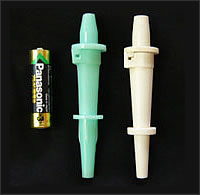
A suspension containing fine particles of several micrometers or more is supplied to a cylindrical container circumferentially at high speed. And as a result it starts to rotate and a centrifugal force is generated. At this time a gravitational acceleration of several tens of thousands of G is generated in the circumferential direction, and thus leading to fast sedimentation and concentration of the fine particles. The separated concentration can be freely selected by changing the supply rate (supply pressure and flow rate) and the flow ratio of the outlet. Our hydrocyclone (liquid cyclone) was designed and manufactured to classify and concentrate fine particles, and so has a small element.

THREE:The best excuse for George II.'s apparent sluggishness was, that the French were now so closely pressed by concentrating armies. Prince Charles of Lorraine and the Austrians were pressing De Broglie so hotly that he was glad to escape over the Rhine near Mannheim; and Noailles, thus finding himself between two hostile armies, followed his example, crossed over the Rhine to Worms, where, uniting with Broglie, they retreated to their own frontier at Lauter, and thus the Empire was cleared of them. The Emperor Charles now suffered the fate which he may be said to have richly deserved. He was immediately compelled to solicit for peace from Austria through the mediation of George of England and Prince William of Hesse. But Maria Theresa, now helped out of all her difficulties by English money and English soldiers, was not inclined to listen to any moderate terms, even when proposed by her benefactor, the King[86] of England. The Emperor was down, and she proposed nothing less than that he should permanently cede Bavaria to her, or give up the Imperial crown to her husband. Such terms were not to be listened to; but the fallen Emperor finally did conclude a treaty of neutrality with the Queen of Hungary, by which he consented that Bavaria should remain in her hands till the conclusion of a peace. This peace the King of England and William of Hesse did their best to accomplish; and Carteret, who was agent for King George, had consented that on this peace England should grant a subsidy of three hundred thousand crowns to the Emperor. No sooner, however, did the English Ministers receive the preliminaries of this contract, than they very properly struck out this subsidy, and the whole treaty fell to the ground.
  • Equipment costs can be reduced.
  • Operating costs can be reduced.
  • Maintenance costs can be reduced.
  • Any change in raw material and product can be easily addressed.
  • Large amounts can be treated in a small area.
  • Separation and cleaning are easy because of the simple structure.
  • Simplified control
  • This equipment can be operated in synchronization with external devices.
  • Alarm and interlock mechanism.
THREE:Such were the means by which the union of Ireland with Great Britain was accomplished, and it would be idle to argue that a majority in the Irish Parliament was not purchased by places, pensions, peerages, and compensation for suppressed seats. But it was a bargain, made above-board, and in the open market. It was, moreover, in agreement with the sentiment of the age, a borough-owner was thought to have a right "to do what he willed with his own," and Pitt, in one of his own Reform bills, had acted on the theory that boroughs were a species of property. Lord Cornwallis, though he acknowledged that he was engaged in dirty work, declared that the union was imperatively necessary, and could be accomplished only by those means. The Irish Parliament was profoundly corrupt, and from no point of view could its extinction be regretted, but that extinction could be accomplished only by further corruption. Nor is there any proof that the Irish nation as a whole were opposed to the union. It was, of course, hard on a pure patriot like Grattan to be involved in the fate of a corrupt gang of placemen, but, as a Protestant, he only[476] represented the minority. The Catholics were either indifferent, with the indifference resulting from long oppression, or in favour of the measure. They knew that from the Irish Parliament it had become, since the Rebellion, hopeless to expect Catholic emancipation; they believed the assurances of Pitt that a measure for their relief would speedily be introduced in the British Parliament. Had he been able to fulfil his promise, the union would have beento use Macaulay's familiar phrasea union indeed.Joseph Mallord William Turner (born in 1775) has been pronounced as "essentially the great founder of English landscape painting, the greatest poet-artist our nation has yet produced. He excelled in everythingfrom the mere diagram and topographic map to the most consummate truth and the most refined idealism. In every touch of his there was profound thought and meaning." He was unrivalled in storms; as Napoleon said of Kleber, "He wakes on the day of battle." The remark of Admiral Bowles, when looking at Turner's "Wreck of the Minotaur," conveyed the highest compliment to his art"No ship could live in such a sea." His "Man Overboard" is a still higher effort of genius, in conveying an expression of horror and utter despair. He was the best illustrator of our national poets. He made known to Englishmen[432] the beauties of their native land, and made them acquainted with the picturesque on the Continent. He gave our young artists love for colour, and made us the Venetians of the modern school. From "The fighting Temeraire tugged to her last Moorings," to "Wilkie's Burial," and the "Burning of the Houses of Parliament," he let no event of his age pass without record or comment. He died in 1851.
  • Classification and concentration for the manufacture of inorganic powder materials
  • Classification of ceramic materials
  • Removal of fine particles, including iron powder
  • Removal of fine particles from pigments
  • Removal of fine organic particles from solvents
  • Separation of starch and yeast
  • Removal of fine particles from high-temperature strong acid solutions
  • Removal of fine particles from low-temperature solutions